
Lab Mission Statement:
"Define the molecular logic of cell fate": We investigate the molecular mechanisms that establish, maintain, and reshape cellular identity in development and cancer. Building on our foundation in stem cell biology, pluripotency, totipotency, and germ cell development, we study how transcription factors, chromatin regulators, RNA metabolism, and nuclear organization coordinate cell-fate decisions.
"Developmental biology as a foundation for cancer discovery": We apply these principles to cancer, with particular emphasis on tumor dormancy and triple-negative breast cancer, to identify vulnerabilities that may inform new therapeutic strategies.
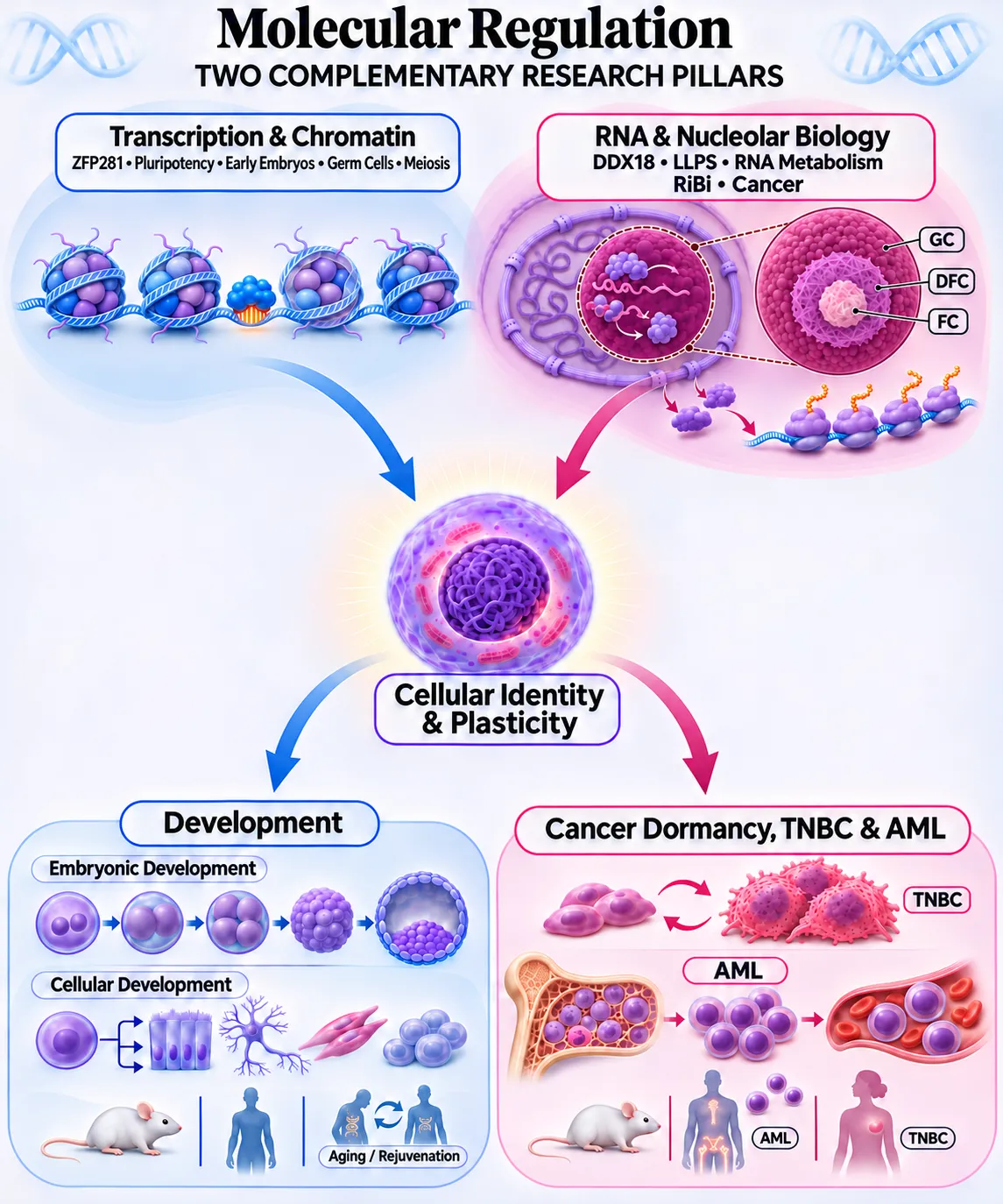
Our previous and ongoing research projects encompass the following two major areas
We define how transcription factors and chromatin regulators establish developmental potential, direct cell-state transitions, and influence regeneration, aging, and cancer.
We investigate the transcriptional and epigenetic mechanisms that establish, maintain, and remodel cellular identity. Our work on ZFP281 provides a framework for understanding how transcription factors coordinate pluripotent-state transitions, chromatin regulation, and developmental potency. We extend these studies across totipotency, early embryonic development, germ cell development, and meiosis.
We also study how established cell identities can be erased, rebuilt, or redirected during somatic-cell reprogramming. By defining molecular barriers and enabling mechanisms, we aim to develop principles for controlled cell-fate engineering and regenerative medicine. An emerging direction examines how developmental and reprogramming programs intersect with genome maintenance, stem-cell exhaustion, cellular aging, and rejuvenation.
These principles also guide our study of cancer dormancy. We examine how transcriptional and chromatin states enable tumor cells to enter, maintain, or escape dormancy, and how developmental regulators influence tumor initiation, metastatic latency, and recurrence.
CORE TOPICS
- ZFP281
- Pluripotency and pluripotent-state transitions
- Totipotency and early development
- Somatic-cell reprogramming
- Germ cell development and meiosis
- Transcriptional and epigenetic regulation
- Regeneration, aging, and rejuvenation
- Cancer dormancy and metastatic latency
We investigate how RNA-regulatory networks and nuclear organization support malignant cell states, focusing on actionable mechanisms in acute myeloid leukemia and breast cancer.
We study how RNA metabolism and nuclear organization shape cellular identity in both normal and malignant contexts. Our work on DDX18 examines how RNA-helicase activity, nucleolar organization, chromatin architecture, and ribosome biogenesis coordinate cell-state regulation. We are particularly interested in how these processes intersect with biomolecular condensates, translational control, and nuclear stress-response pathways.
In acute myeloid leukemia (AML), we investigate how nuclear RNA-binding proteins preserve leukemic identity and stemness. We show that PSPC1 cooperates with PU.1 on chromatin to sustain leukemic transcription, inhibit myeloid differentiation, and maintain AML, revealing a therapeutic vulnerability that may spare normal hematopoiesis. In triple-negative breast cancer (TNBC), we study how RNA-regulatory and nuclear mechanisms sustain tumor-cell plasticity, survival, and treatment resistance.
By integrating mechanistic studies of RNA and nuclear biology with AML and breast-cancer models, we aim to identify molecular dependencies that can be translated into new therapeutic strategies.
CORE TOPICS
- DDX18
- PSPC1–PU.1 regulation in AML
- RNA metabolism, Ribosome biogenesis, and translational control
- Biomolecular condensates and phase separation
- Nucleolar and nuclear organization
- Cell-state plasticity and cancer stemness
- Triple-negative breast cancer
- Therapeutic vulnerabilities