Engineering synthetic immunity against myeloid malignancies
The Haubner Lab develops gene-engineered cellular therapies targeting myeloid malignancies, leveraging synthetic receptor design and immune cell engineering informed by target biology and the bone marrow microenvironment, to improve patient outcomes. We are part of the Columbia Institute for Cell Engineering and Therapy (CICET).
We are hiring! Interested trainees and postdoctoral candidates can contact Sascha Haubner: [email protected]
Chimeric antigen receptor (CAR) T cell therapy has revolutionized the field of cellular immunotherapy and yields long-term remissions in several hematological malignancies including B cell acute lymphoblastic leukemia (B-ALL), B cell non-Hodgkin lymphomas (B-NHL) and multiple myeloma. Even though CAR T cell therapy has in principle the potential to achieve similar outcomes in acute myeloid leukemia (AML), re-directing the approved CD19-specific CAR designs against myeloid target antigens has been associated with AML resistance and myeloablative toxicities. These efficacy and safety limitations owe in large part to the challenge of identifying suitable target antigens and designing adequate receptors for effective recognition and safe elimination of AML.
CAR T cell therapy in AML requires novel approaches that better adapt to the specific target biology and the associated bone marrow microenvironment. Multi-antigen targeting, logic-gating and emerging cell engineering solutions offer new possibilities to better direct T cell specificity and sensitivity towards AML, and investigation of AML-intrinsic resistance and leukemic microenvironmental factors is poised to reveal additional targetable AML vulnerabilities.
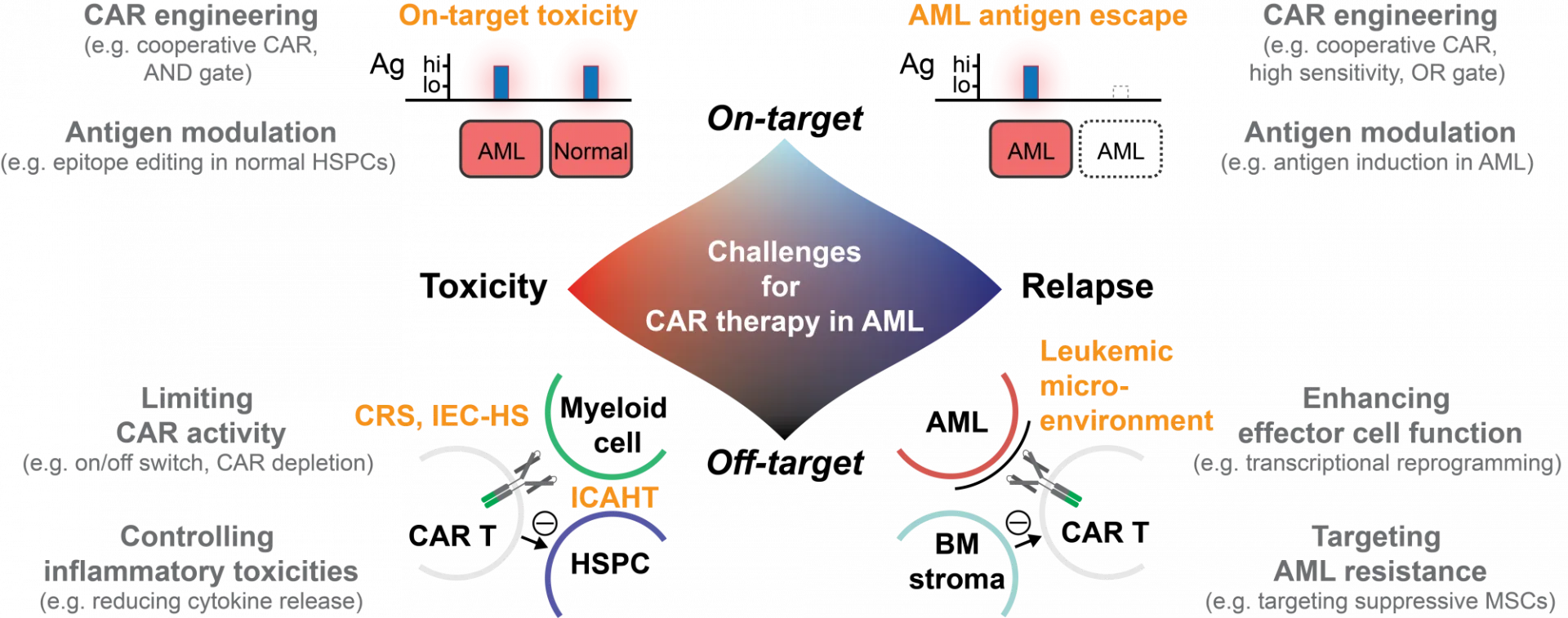
The Haubner Lab leverages genetic engineering, pre-clinical models and patient samples to understand mechanisms of AML resistance and toxicities in the context of CAR therapies including those under current clinical investigation, to rationally adapt novel CAR strategies to the complex AML biology and microenvironment. Our mission is to transform mechanistic insights into clinically translatable engineering solutions to establish synthetic immunity against AML and other myeloid malignancies.
Jonathan Liu, BS
Staff Associate
Jordan Kesner, PhD
Postdoctoral Research Scientist
John Boom, BSE, BA
MD-PhD dual-degree candidate
Zachary Kulstad, BA
MD-PhD dual-degree candidate
Georgios Kladis, MS
Staff Associate
The Haubner Lab is part of the Columbia Institute for Cell Engineering and Therapy (CICET), the Columbia Stem Cell Initiative (CSCI), the Edward P. Evans Center for Myelodysplastic Syndromes (MDS) and the Herbert Irving Comprehensive Cancer Center (HICCC), in a collaborative environment between synthetic immunology, cancer biology and systems biology, at the Columbia University Irving Medical Center (CUIMC).
- Review article on CAR therapy for AML
Haubner S, Subklewe M, Sadelain M. Honing CAR T cells to tackle acute myeloid leukemia. Blood. 2025 Mar 13;145(11):1113-1125. doi: 10.1182/blood.2024024063. PMID: 39630061.
- Cooperative CAR targeting in AML (study led to clinical translation: NCT05748197)
Haubner S, Mansilla-Soto J, Nataraj S, Kogel F, Chang Q, de Stanchina E, Lopez M, Ng MR, Fraser K, Subklewe M, Park JH, Wang X, Rivière I, Sadelain M. Cooperative CAR targeting to selectively eliminate AML and minimize escape. Cancer Cell. 2023 Nov 13;41(11):1871-1891.e6. doi: 10.1016/j.ccell.2023.09.010. Epub 2023 Oct 5. PMID: 37802054; PMCID: PMC11006543.
- Targeting AML via HLA-independent T cell receptor
Mansilla-Soto J, Eyquem J, Haubner S, Hamieh M, Feucht J, Paillon N, Zucchetti AE, Li Z, Sjöstrand M, Lindenbergh PL, Saetersmoen M, Dobrin A, Maurin M, Iyer A, Garcia Angus A, Miele MM, Zhao Z, Giavridis T, van der Stegen SJC, Tamzalit F, Rivière I, Huse M, Hendrickson RC, Hivroz C, Sadelain M. HLA-independent T cell receptors for targeting tumors with low antigen density. Nat Med. 2022 Feb;28(2):345-352. PMID: 35027758; PMCID: PMC9469647.
- Differential surface antigen expression in large AML patient cohort
Haubner S, Perna F, Köhnke T, Schmidt C, Berman S, Augsberger C, Schnorfeil FM, Krupka C, Lichtenegger FS, Liu X, Kerbs P, Schneider S, Metzeler KH, Spiekermann K, Hiddemann W, Greif PA, Herold T, Sadelain M, Subklewe M. Coexpression profile of leukemic stem cell markers for combinatorial targeted therapy in AML. Leukemia. 2019 Jan;33(1):64-74. PMID: 29946192; PMCID: PMC6326956.
Columbia University Irving Medical Center
William Black Medical Research Building
650 W 168th St
New York, NY 10032